MR. ROBOT · CYBERSECURITY · SYSTEMS
22 min read · spoiler-lightMr. Robot, trust boundaries and the systems behind a hack.
The show is interesting because the terminal is rarely the whole story. The real attack surface is the system around it: people, privileges, networks, hardware, software, suppliers and operational habits.
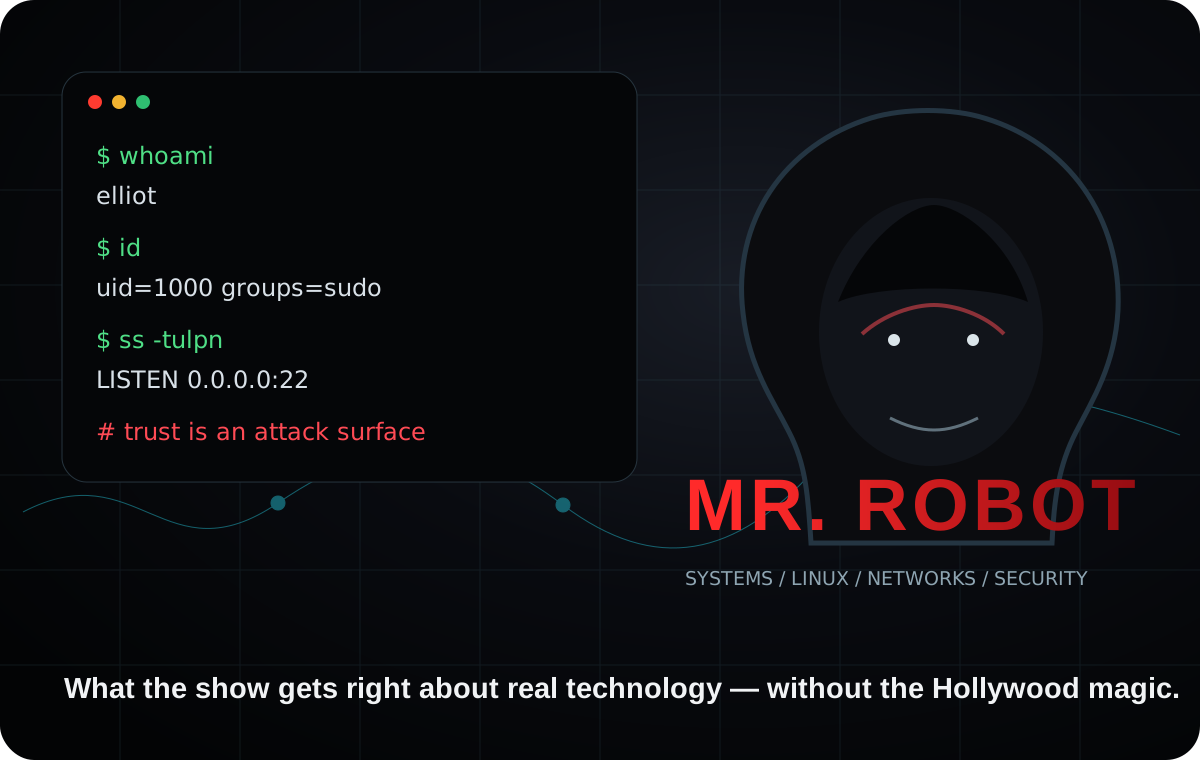
One of the most memorable things about Mr. Robot is how ordinary the technology often looks. There is no glowing “hack” button. There are laptops, Linux terminals, Wi-Fi networks, USB devices, credentials, phones, offices and people making decisions under pressure. That is much closer to real systems engineering than the usual Hollywood version of cybersecurity.
The useful question is therefore not “which command did Elliot type?” It is: what trust relationship was the system relying on, and how could that trust fail?
1. Start with the system, not the exploit
A security problem almost never lives in one isolated application. A company might have identity services, endpoints, cloud systems, routers, VPN gateways, databases, industrial networks, third-party software and human workflows. Each connection is an interface. Each interface creates assumptions about identity, data, timing and trust.
From a systems perspective, cybersecurity is the analysis of what happens when one of those assumptions is false. Is the user really who the system thinks they are? Is the endpoint still trusted? Is the message authentic? Is the service exposing more capability than the caller needs?
2. Why Linux and the terminal appear so often
Unix-like systems make system state observable. Processes, users, permissions, sockets, services and logs are represented through interfaces that are easy to inspect and automate. That does not make Linux “a hacker operating system.” It makes it a powerful engineering environment for servers, development, automation and security analysis.
$ whoami
ibrahim
$ id
uid=1000(ibrahim) gid=1000(ibrahim) groups=1000,27(sudo)
$ ps aux | head
$ ss -tulpn
$ journalctl -p warning
Each command answers a system question: who am I, what privileges do I have, what is running, what is listening on the network and what failures have been logged? Security starts with observability because you cannot defend a state you cannot see.
3. Root is a trust boundary
On Unix-like systems, UID 0 traditionally represents the superuser. Root can bypass many discretionary access controls and modify parts of the system that ordinary users cannot. The engineering lesson is not that “root is powerful.” It is that privilege is a boundary, and boundaries should be crossed only when necessary.
| Layer | Defensive question |
|---|---|
| User account | Does this identity have only the access required for its role? |
| Application | Does the service run with unnecessary operating-system privileges? |
| Container / VM | Can compromise escape into the host or neighbouring workloads? |
| Administrator | Are privileged actions strongly authenticated, logged and reviewable? |
This is the logic of least privilege: reduce the amount of damage that any single mistake, compromised account or vulnerable component can cause.
4. A vulnerability is not yet an incident
A vulnerability is a weakness. An exploit is a way of turning a weakness into unintended behaviour. An incident occurs when that behaviour affects confidentiality, integrity, availability or safety. These are different stages, and good security engineering puts controls between them.
That chain matters because many security controls do not “remove every bug.” Network segmentation can reduce reachability. Application sandboxing can limit privilege. Monitoring can shorten detection time. Backups can reduce recovery impact. Defense-in-depth works by making the attacker cross multiple independent barriers.
5. Networks are graphs of trust
A network diagram is more than IP addresses and switches. It is a map of which systems are allowed to communicate. In a flat network, compromise of one endpoint may expose many services. Segmentation converts one large trust zone into smaller zones with explicit paths between them.
Firewalls, VLANs, access-control lists and zero-trust policies are implementation mechanisms. The systems-engineering question comes first: which communication is required for the mission, which is optional and which should never be possible?
6. Authentication is not the same as authorisation
Authentication answers “who are you?” Authorisation answers “what are you allowed to do?” Systems often get into trouble when these are mixed together. A valid user session does not mean every API operation should be available to that user.
| Control | Question | Typical failure |
|---|---|---|
| Authentication | Who is the caller? | weak credentials, stolen session, insecure recovery |
| Authorisation | What may the caller do? | excessive role, missing object-level check |
| Accounting | What did the caller do? | missing logs, weak timestamps, no correlation |
This is why identity architecture is a system concern, not a login-form concern.
7. Social engineering is an interface failure
Mr. Robot repeatedly shows that people are part of the system. That is not a cynical point; it is an engineering one. Humans operate recovery procedures, approve requests, connect devices, reuse passwords, interpret alerts and make exceptions when work is urgent.
A secure process should therefore be designed so that one believable phone call, one urgent email or one mistaken click cannot silently bypass every other control. Strong processes use independent verification, constrained permissions, multi-factor authentication and clear escalation paths.
8. Persistence changes the problem
Preventing initial compromise is only one objective. Another is preventing an attacker from remaining inside the environment after the original weakness is fixed. Persistence can involve accounts, scheduled tasks, modified services, credentials or cloud access paths. Defenders therefore need a baseline of what “normal” configuration looks like.
9. Logging is a measurement system
Logs are often treated as storage rather than measurement. A useful security log has a defined event, timestamp, source identity, context and integrity model. If timestamps disagree across hosts, identities are ambiguous or logs can be altered without detection, incident reconstruction becomes guesswork.
This is surprisingly similar to industrial metrology: the quality of the conclusion depends on the quality and traceability of the measurement system.
10. IT and OT change the meaning of “impact”
In ordinary IT systems, a security failure might expose data or interrupt a service. In industrial environments, software and networks interact with physical equipment. Availability and integrity can therefore become safety and production concerns.
| IT-centric question | OT / industrial extension |
|---|---|
| Can the service be unavailable? | What process stops, and is shutdown safe? |
| Can data be modified? | Can modified data change control or quality decisions? |
| Can we patch immediately? | Will patching interrupt validated production equipment? |
| Can we isolate the host? | Does isolation affect control loops or plant availability? |
11. The real lesson of the show
The reason Mr. Robot feels technical is not only that the screen content looks believable. It understands that technology is made of dependencies. A person trusts a process. A process trusts an identity provider. A service trusts a network path. An application trusts an input. A backup trusts the same software as the primary system.
Attackers look for the assumption that was never verified. Defenders should do the same thing first.
That is why cybersecurity is closely related to systems engineering, testing and validation. Security is not a layer you add after a system works. It is part of the definition of what “works” means.