SUSTAINABILITY · ENERGY · MANUFACTURING
22 min readA solar roof does not make a factory sustainable.
PV is visible. The harder work is underneath: understanding the load, reducing waste, coordinating storage and demand, and checking whether an improvement still makes sense across its lifecycle.
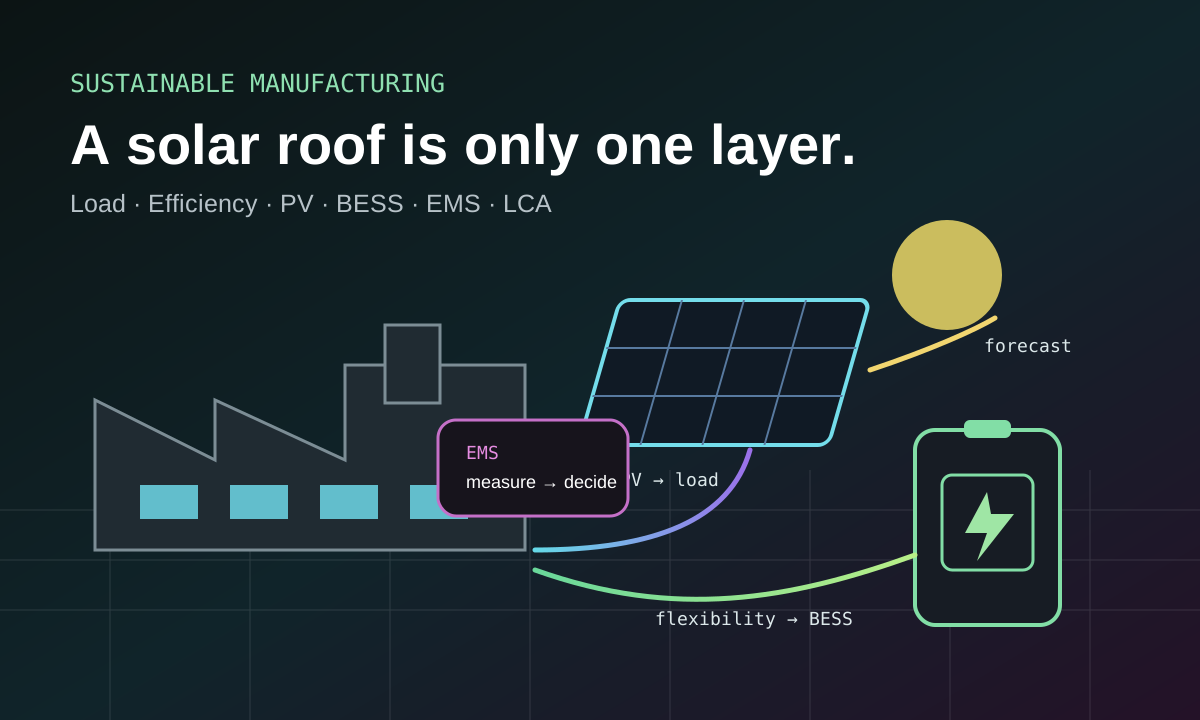
Imagine two factories with the same photovoltaic system on the roof. The first has stable processes, efficient equipment and a load profile that overlaps well with solar generation. The second has compressed-air leaks, unnecessary idle loads, poor scheduling and large evening peaks.
Both can publish the same installed PV capacity. They do not have the same energy performance.
1. First understand where the energy goes
An industrial energy balance should separate productive energy from conversion losses, idle consumption and avoidable demand. Motors, compressed air, HVAC, thermal processes, lighting, servers and auxiliary systems can have very different load behaviour.
This ordering matters. Installing renewable generation before removing obvious waste can mean spending capital to supply inefficiency with lower-carbon electricity.
2. Power and energy answer different questions
Power is an instantaneous rate, typically measured in kW. Energy accumulates power over time and is measured in kWh. A 200 kW peak lasting ten minutes and a 200 kW load lasting eight hours create very different energy and infrastructure requirements.
This is why an annual electricity bill is not enough for system design. PV, storage and demand-response decisions require a time-resolved load profile.
3. PV value depends on coincidence, not only annual production
A photovoltaic system can generate a large annual energy total and still have limited direct value if production occurs when the factory load is low. Self-consumption depends on the overlap between generation and demand.
These two ratios answer different questions. A small PV system may have nearly 100% self-consumption but cover only a small part of total demand. A large PV system may cover more demand annually but export significant midday surplus.
4. Efficiency changes the size of every downstream solution
If an efficiency project reduces the factory load before PV or storage is sized, the required generation and storage capacity may also fall. That is one reason “efficiency first” is often technically powerful: it reduces both operating energy and the infrastructure needed to supply that energy.
| Action | System effect |
|---|---|
| Reduce compressed-air leaks | lower continuous electrical load |
| High-efficiency motors / VSDs | lower process energy and peak demand |
| Idle-state control | lower non-productive baseload |
| Heat recovery | reduces separate thermal-energy demand |
| Scheduling | can improve overlap with renewable generation |
5. BESS is not just “store solar for later”
A Battery Energy Storage System can perform several functions: increase PV self-consumption, shave demand peaks, shift energy in time, provide backup capability or support grid services. Those objectives can compete with each other.
A battery reserved for backup is not fully available for arbitrage. A battery cycled aggressively for peak shaving accumulates degradation. The control strategy therefore matters as much as nominal capacity.
Real design also includes power limits, depth-of-discharge constraints, thermal limits, degradation and minimum reserve requirements.
6. Demand response turns the load into a controllable resource
Not every industrial load must occur at an exact second. Some processes, charging tasks, thermal loads or auxiliary systems can shift within production constraints. Demand response uses that flexibility to reduce peaks, follow renewable generation or respond to grid conditions.
The last step is essential. An energy optimisation that damages takt time, quality or equipment life is not a valid industrial optimisation.
7. An EMS is a control problem, not a dashboard
An Energy Management System should connect measurements to decisions. It can ingest meter data, production schedules, PV forecasts, tariffs, battery state and operational constraints, then recommend or execute actions.
| EMS layer | Engineering role |
|---|---|
| Measurement | meters, sensors, production and environmental data |
| Context | associate energy with lines, products, shifts and operating states |
| Forecast | load, PV generation, production and tariffs |
| Optimisation | choose setpoints or schedules under constraints |
| Verification | check whether expected savings actually occurred |
8. Microgrids connect DER into one operating system
A microgrid can coordinate local generation, storage, flexible loads and the utility connection. The technical challenge is not only electrical sizing; it is control across different time scales and objectives.
At one level the system must maintain power quality and equipment limits. At another it may minimise cost or carbon. At another it must respect production priorities. Good control architecture separates these objectives while ensuring they do not conflict.
9. Carbon accounting needs the right denominator
Total annual emissions are important, but industrial decisions often need intensity metrics as well: kgCO₂e per good unit, kWh per part, or emissions per functional output. Without a production-normalised metric, a factory can appear to improve simply because it produced less.
10. LCA changes the question from “efficient here” to “better overall”
Life Cycle Assessment expands the boundary beyond factory electricity. It considers raw-material extraction, manufacturing, transport, use and end-of-life according to the defined goal, scope and functional unit.
The Life Cycle Inventory records relevant inputs and outputs. Life Cycle Impact Assessment translates those flows into environmental impact categories. Interpretation then checks hotspots, assumptions, sensitivity and whether the result actually supports the original decision.
11. The functional unit prevents misleading comparisons
Comparing “one kilogram of material A” with “one kilogram of material B” can be meaningless if the two materials provide different service life, stiffness or performance. LCA comparisons need a functional unit representing equivalent function.
12. Renewable does not mean impact-free
PV modules, batteries and power electronics have manufacturing impacts, material requirements and end-of-life considerations. This does not cancel their operational benefits; it means engineering decisions should account for embodied impacts as well as avoided operating emissions.
LCA is useful precisely because it prevents burden shifting: reducing one impact while unintentionally increasing another somewhere else in the lifecycle.
13. Sustainability and manufacturing performance can support each other
Scrap reduction lowers material impact and often energy per good unit. Predictive maintenance can avoid inefficient degraded operation and unplanned losses. Better scheduling can reduce peaks and increase PV self-consumption. Quality improvement prevents the energy and material embodied in defective products from being wasted.
This is where Sustainable Manufacturing becomes an engineering discipline rather than a reporting exercise: environmental performance becomes one of the system objectives alongside cost, quality, throughput and reliability.
14. A sustainable factory is a controlled system
The real goal is not the presence of a particular technology. It is a production system that measures its resource use, understands its constraints, reduces avoidable demand, supplies the remaining demand efficiently, and verifies the effect of each change.
A solar roof can be part of that system. It is not the system by itself.